
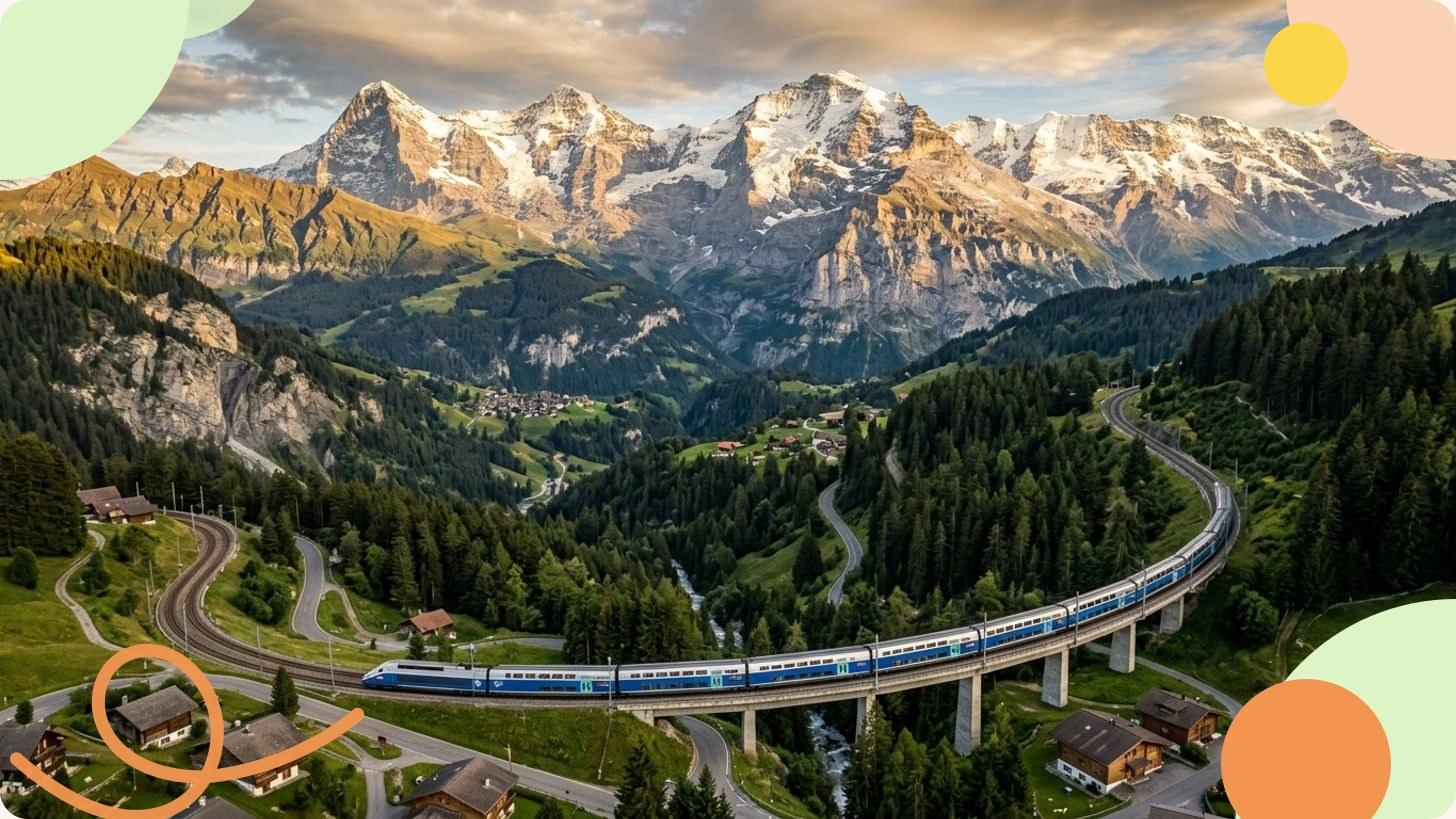

Travelling by train in Europe means going from city centre to city centre, with no security queues and no out-of-town airport to contend with. On routes under four hours, the time saving over flying is real. The European rail network spans 40,000 destinations across 33 countries, with high-speed main lines, scenic Alpine railways and, from 2026, a new wave of overnight connections between capital cities.
Why the Train Actually Changes Your Trip
City centre to city centre. Gare du Nord, St Pancras and Wien Hauptbahnhof sit right in the heart of their cities. No transfer needed. On Paris-London, the Eurostar takes 2h16 platform to platform: once you factor in airport transfers on both sides, flying gains nothing on this route.
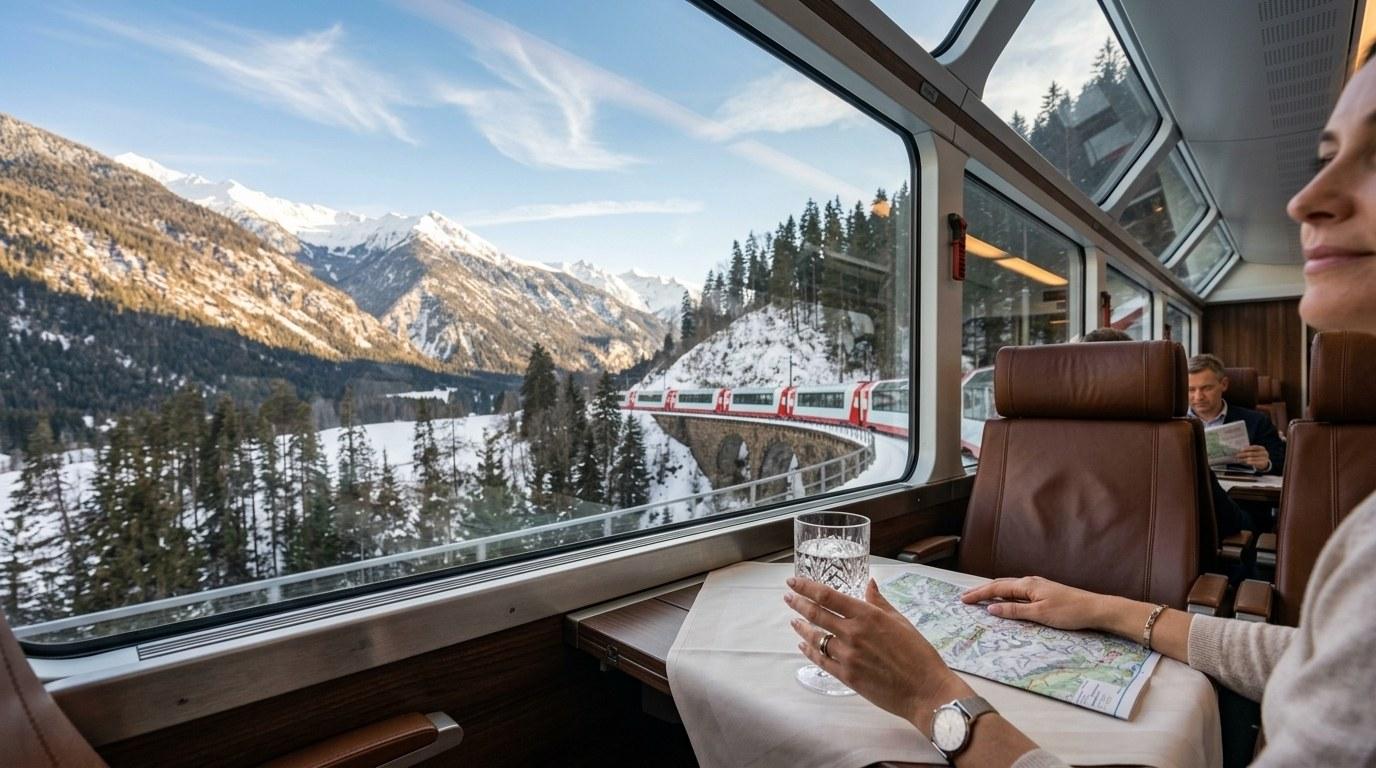
Fewer hassles on board. No strict cabin baggage limits, no seatbelt requirement during the journey. You can get up, change seats or head to the dining car whenever you like.
A lighter carbon footprint. Rail remains one of the lowest-emission modes of transport per passenger-kilometre across the European continent.
Iconic Rail Routes to Put on Your List
London - Paris: the Eurostar in 2h16
This is the route that has converted more travellers to rail than any other. The Eurostar links Gare du Nord to St Pancras International in 2h16, with around 15 departures a day. Allow roughly 30 minutes before departure for immigration checks. Tickets from €39 if you book early.
If you are planning a trip to London, our guide What to do in London? has plenty of ideas to fill every day.
Vienna - Venice: the ÖBB Nightjet
The Nightjet between Vienna and Venice is still running in 2026. Depart Vienna at 21:39 and arrive at Venezia Santa Lucia at 08:34 the following morning: you wake up on the lagoon. The train offers couchettes in 4- or 6-berth compartments, as well as private sleeping cabins with en-suite toilet and shower. Fares from €59 in a 6-berth couchette.
Paris - Barcelona: the TGV through the Pyrenees
From Gare de Lyon, a direct train reaches the heart of Barcelona in around 6h30. The journey runs along the Languedoc coast and cuts through the Pyrenees, scenery that alone justifies choosing the train. Among the best Southern European destinations for summer, Barcelona is one of the most accessible by rail from Paris. Tickets from €49 when booked in advance.
Glacier Express: the Alps from Zermatt to St Moritz
The Glacier Express links Zermatt to St Moritz through 291 km of Swiss Alps, crossing 291 bridges and 91 tunnels, with the highest point at the Oberalp Pass (2,033 m). The journey takes around 8 hours: this is one of the rare occasions when you actively hope the train will be slow. Seat reservations are compulsory (CHF 54 in 1st or 2nd class since December 2025) and should be booked as early as possible, especially in summer when the train runs twice a day.
Night Trains in 2026: What’s Changed
The European night train network reached a turning point at the end of 2025. Here is what you need to know before booking.
What has stopped. The ÖBB Nightjet services operated jointly with SNCF on Paris-Berlin and Paris-Vienna were withdrawn on 14 December 2025, due to a lack of French public funding. The seasonal Brussels-Venice service also ceased running.
What has started. European Sleeper, the Belgian-Dutch rail cooperative, launched an alternative Paris-Berlin service on 26 March 2026: three departures a week (Tuesdays, Thursdays and Sundays) from Gare du Nord at 17:45, arriving in Berlin the following morning at 09:59. Couchettes start at around €59. An Amsterdam/Brussels-Milan service is planned for later in 2026.
What has improved. The new Koralm line, opened in Austria on 14 December 2025, cuts the Graz-Klagenfurt journey to just 41 minutes (down from 2 hours) and speeds up daytime services between Vienna and Italy.
Interrail or Single Tickets: Which Is Right for You?
The Interrail Global Pass covers up to 33 countries on a single pass. It comes in a Flexi version, with a set number of travel days within a period (for example 5 days within 1 month), or as a continuous pass for a fixed duration. It becomes worthwhile from around 4 or 5 different countries, or if you want the freedom to travel without buying a new ticket at every step.
For a trip through 2 or 3 countries, individual tickets bought in advance on Trainline or Omio often work out cheaper. One thing to keep in mind: an Interrail pass does not cover reservation fees on major routes. The Eurostar, the Paris-Barcelona TGV and the Glacier Express all require a paid supplement, even with the pass.
If you are looking for inspiration to build your itinerary, our pick of European destinations for this summer can help you choose your stops.
Practical Tips for a Smooth Journey
Book early. Eurostar and Paris-Barcelona TGV tickets sell fast in high season. Less than a fortnight before departure, prices tend to spike.
Compare platforms. Trainline, Omio and national rail websites (SNCF Connect, ÖBB, DB) sometimes show different prices for the same trains. Check several sources before buying.
Travel light. Not every European station has lifts at every platform. A bag you can carry up stairs will save you a great deal of stress.
Validate your ticket. In Italy and Spain in particular, regional tickets must be validated before you board, or you risk a fine.
Don’t Travel Without Travel Insurance
A long delay that makes you miss a connection, an unexpected hospital stay abroad, luggage lost during a train change: these things happen even to the most organised travellers. Yupwego covers your medical expenses abroad and handles your repatriation if your condition requires it, with no upfront costs on your part. You can take out a policy online in a matter of minutes, before you leave.
Protect my European tripFAQ
Is the train actually cheaper than flying in Europe?
On short and medium distances (under 4 hours), yes, as long as you book early. On Paris-London or Paris-Barcelona, train fares are often comparable to flights, but the train wins on real travel time (no airport transfers) and comfort. On longer routes such as Paris-Budapest, flights tend to be cheaper at base fare.
What is the Interrail Global Pass?
A pass covering up to 33 European countries, available in a Flexi version (set travel days within a period) or continuous (fixed duration). It is open to European residents only. Non-Europeans buy the equivalent Eurail Pass, on the same terms. Factor in that reservation fees on major routes (Eurostar, TGV, night trains) are charged on top of the pass.
Are night trains in Europe safe?
Yes. Compartments on ÖBB Nightjet and European Sleeper trains can be locked from the inside. Keep your valuables with you rather than in the overhead luggage racks.
Can you travel by train from Paris to Scandinavia?
Yes, by combining several trains. Norway can be reached from Paris via Brussels, Amsterdam, Copenhagen and Oslo, ideally in several legs or by combining daytime and overnight trains.
Does my travel insurance cover incidents that happen on a train?
A Yupwego policy covers medical expenses incurred abroad, regardless of your mode of transport. If your condition requires repatriation, Yupwego arranges and covers it. For baggage or delay cover, the details vary depending on the plan you choose: check your policy documents before departure, or find all the answers in the Yupwego FAQ.